Websites
What Should a Professional Business Website Include?
A professional website is more than a great-looking design. Discover the essential elements a modern business website needs to be fast, user-friendly, trustworthy, and effective at attracting customers.
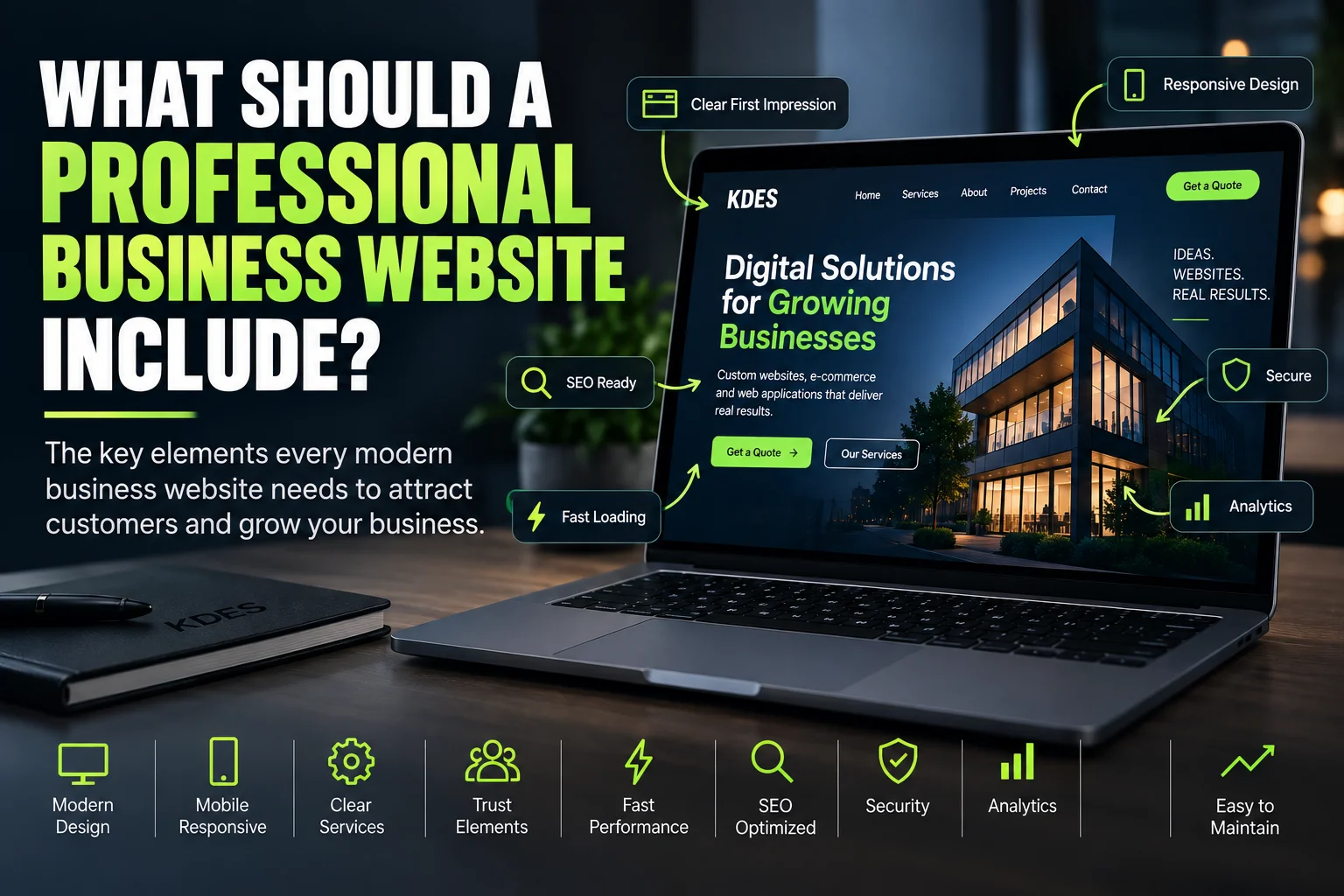
A professional business website is more than a great-looking design and a company logo. It is a digital platform that should help your business attract customers, present its services, and build trust.
If a website looks good but visitors can't quickly understand what the business offers, how to get in touch, or why they should choose that company, its potential is not being fully used.
So what should a professional business website actually include?
1. A Clear and Understandable First Screen
Within the first few seconds, visitors should be able to understand three things:
- who your company is;
- what you offer;
- what the visitor should do next.
That is why the first screen of a website shouldn't consist only of an attractive image or an abstract slogan.
A good hero section briefly explains your offer and provides a clear call to action, such as "Get a Quote", "Contact Us", or "View Our Services".
The goal isn't to say everything at once. The goal is to make visitors want to learn more.
2. Responsive and Modern Design
Your customers may visit your website from a desktop, tablet, or smartphone. Your website therefore needs to adapt to different screen sizes.
Responsive design means that content, images, buttons, navigation, and other website elements remain easy to use regardless of the device.
But responsiveness isn't just a technical requirement. It is an important part of the user experience.
If your website is difficult to use on a phone, you may lose customers before they even discover what you offer.
3. Clearly Structured Services or Products
Visitors shouldn't have to search through your entire website to understand what you offer.
Your services or products should be easy to find and explained in a clear, understandable way.
Each service section should ideally answer the most important customer questions:
- What is it?
- Who is it for?
- What problem does it solve?
- What benefit does the customer receive?
- How can the customer learn more or get started?
This structure helps visitors understand your offering faster and reduces the need for them to search for answers themselves.
4. Information About Your Business
Potential customers want to know who they are going to work with.
That is why a professional website should include information about your company, its experience, values, team, or approach to work.
This section doesn't need to be a long history of the company. It should answer a simple question:
Why should a customer trust you?
A well-written "About Us" section can help create a more personal connection between your business and potential customers.
5. Trust-Building Elements
When someone visits your website for the first time, they don't automatically know whether your business is trustworthy.
A professional website should therefore provide evidence of your experience and the quality of your work.
This can include:
- customer testimonials;
- completed project examples;
- portfolio work;
- case studies and results;
- partner or client logos;
- certifications and qualifications;
- specific business achievements or statistics.
People are more likely to trust a business when they can see evidence rather than just promises.
6. Clear Calls to Action
A website shouldn't only provide information. It should help visitors take the next step.
This is where calls to action, or CTAs, become important.
Examples include:
- "Get a Quote";
- "Contact Us";
- "Book a Consultation";
- "View Services";
- "Request Pricing";
- "Order Now".
Your CTA should be visible and easy to understand. Visitors shouldn't have to ask themselves, "What am I supposed to do now?"
7. Fast Loading and Good Performance
A beautiful website doesn't provide much value if it takes too long to load.
Website speed can be affected by image sizes, code quality, server configuration, hosting, third-party scripts, and many other technical factors.
That is why performance should be considered during development rather than treated as something to fix after launch.
A fast website improves the user experience and helps visitors reach the information they need more quickly.
As we discussed in our previous article about hosting, quality infrastructure also plays an important role in website speed, stability, and security.
8. An SEO-Friendly Structure
A great-looking website isn't enough if potential customers can't find it.
A professional website should therefore be built with SEO principles in mind from the beginning.
This can include:
- proper heading structure;
- semantic HTML;
- optimized meta tags;
- fast loading;
- mobile-friendly structure;
- search-engine-friendly URL structure;
- optimized images;
- a technical structure that can be properly indexed.
SEO isn't simply something that should be added after a website has been built. A strong technical foundation starts with the development itself.
9. Security
A business website needs to be not only convenient but also secure.
This becomes especially important when the website uses contact forms, user accounts, payments, or other sensitive information.
The foundation of website security can include:
- HTTPS;
- secure server configuration;
- secure form data handling;
- regular updates;
- backups;
- access control.
Security isn't a feature that visitors should have to think about. It should simply work in the background.
10. Analytics and Data Tracking
How can you know whether your website is working if you don't know what is happening on it?
Analytics tools can help you understand how many people visit your website, where they come from, which pages they view, and what actions they take.
Google Analytics and Google Search Console can help businesses make decisions based on actual data rather than assumptions.
A website isn't a one-time project — it is part of your business's digital presence that can be measured and improved over time.
11. Easy Maintenance and Room to Grow
Businesses change over time. New services are added, prices change, new projects are completed, and the number of customers grows.
Your website should therefore be built with future growth in mind.
A good technical solution makes it possible to add new sections, functionality, integrations, or other features in the future without rebuilding the entire website from scratch.
A professional website isn't just a solution for today. It should be flexible enough to support your business as it grows.
A Professional Website Is More Than Design
Good website design is certainly important, but it is only one part of the equation.
A professional business website needs to combine design, usability, speed, SEO, security, clear structure, and business objectives.
Your website should work for your business, not simply exist on the internet.
Does Your Business Need a New Website?
KDES develops custom business websites with tailored design, responsive layouts, SEO-optimized code, fast loading, and functionality built around your business needs.
We don't simply create an attractive website — we develop a digital solution designed around a specific business and its goals.
Tell us about your project and we'll help you determine what your new website should include.